


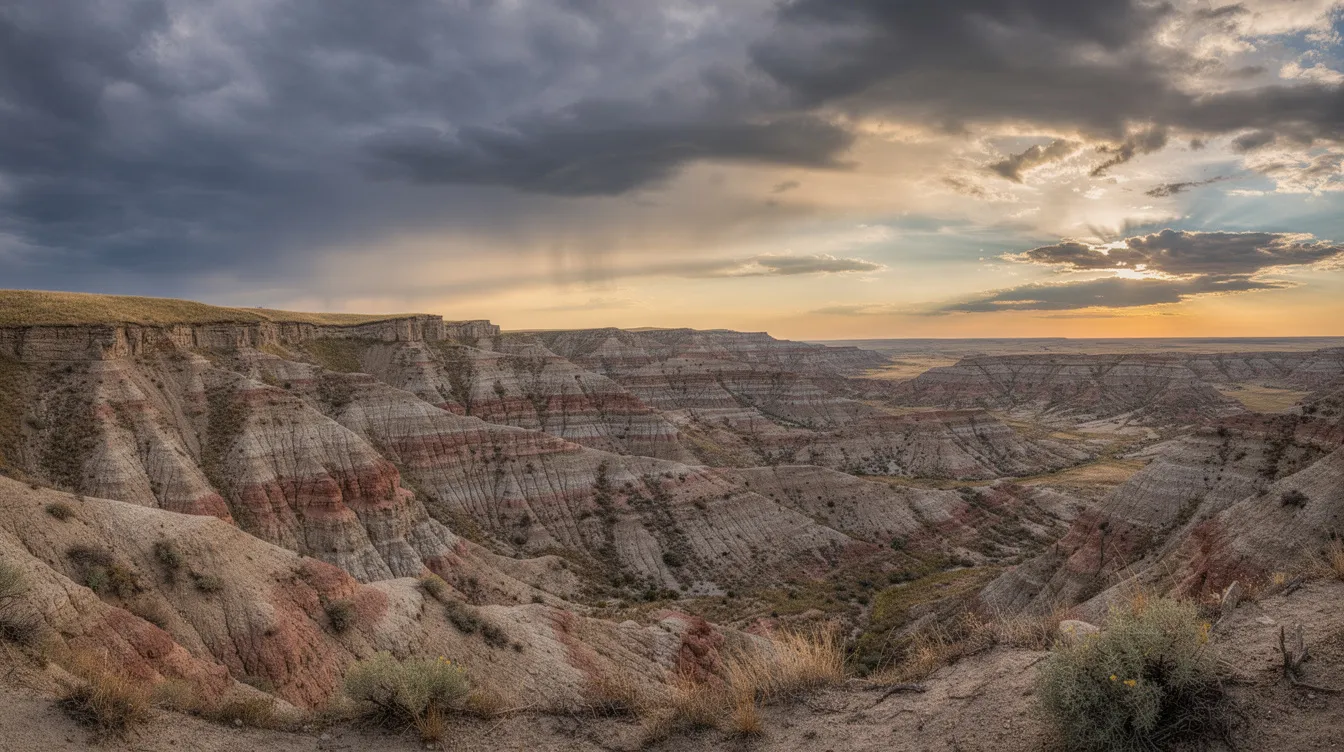
The Theodore Roosevelt Presidential Library is a cultural and educational complex set into a hillside above Medora in North Dakota’s Badlands. It opened to the public on July 4, 2026, during the state’s America 250 celebration. Construction Executive and other public project materials have described the building as notable for its rammed earth walls, mass timber structure, walkable living roof, and off-grid design strategy.
Why should this project matter to Colorado and Wyoming commercial contractors?
The rest of this article translates the library’s rammed earth walls, mass timber frame, and off-grid systems into practical lessons for estimators, project executives, and superintendents in Colorado and Wyoming.
Rammed earth is a construction method that compresses a carefully prepared earth-based mix inside formwork to create solid walls with visible horizontal lifts. At the Theodore Roosevelt Presidential Library, those walls are a defining architectural feature.
For contractors, the significance goes beyond visuals. Rammed earth changes how the job is planned and executed. Unlike many conventional wall systems, the finished surface is also the exposed finish, which leaves little room for field correction. That raises the stakes for formwork alignment, moisture control, compaction consistency, embed placement, and inspection sign-off.
Rammed earth can also support broader building-performance goals when used in the right assembly, but its performance depends on project-specific engineering, climate response, and detailing. In Colorado and Wyoming, that means contractors should approach the material as a specialized system rather than assume it behaves like a drop-in replacement for concrete, CMU, or insulated wall assemblies.
The real takeaway for Rocky Mountain firms is operational: if a future museum, visitor center, campus building, or cultural facility specifies rammed earth walls, the scope will require more front-end validation than many teams are used to carrying on standard institutional work.

TRPL is not only a rammed earth story. Construction Executive’s coverage and public project updates also point to a mass timber structural system, a sweeping living roof, and a broader sustainability strategy focused on reducing dependence on conventional utilities.
That combination matters because it multiplies coordination demands. Mass timber affects erection sequencing, moisture protection, connection planning, and tolerance management. A living roof adds waterproofing, drainage, loading, and long-term installation sequencing concerns. Off-grid or utility-light systems raise the documentation and commissioning burden, especially when the owner is pursuing aggressive sustainability targets.
Public reporting has also framed the library as a certification-driven project. For contractors, those sustainability targets are not marketing details. They can affect procurement, submittals, product selection, commissioning, and closeout expectations from preconstruction through occupancy.
Put simply, TRPL reminds us that modern institutional complexity often comes from the overlap of several uncommon systems at once, not from one unusual material by itself.
Rammed earth may read simply in concept, but field execution is exacting. The sequence typically begins with testing and refining the earth mix, then moves into formwork setup, lift-by-lift placement and compaction, and careful curing and protection. Every stage depends on consistency.
For a contractor, several process implications stand out:
This is where Rocky Mountain teams should treat TRPL as a process benchmark, not a design curiosity. If your firm is used to conventional institutional work, rammed earth walls introduce a different QA/QC mindset, a different formwork challenge, and a different level of irreversible work at each step.
Local approval pathways may also take more effort because many jurisdictions see rammed earth far less often than concrete, masonry, or steel systems. That does not make the material impractical in Colorado or Wyoming, but it does mean contractors should expect more education, more documentation, and more engineer-driven support when these scopes appear.
TRPL sits on a remote hillside above Medora, far from a major metro labor pool. That location is central to the project’s meaning, but it also adds the same logistical pressure contractors face on remote Rocky Mountain work.
The parallels are familiar:
Those conditions should sound familiar to firms building in remote parts of Wyoming, at mountain campuses, in resort corridors, or on public projects with constrained site access. Public project materials have also highlighted local sourcing for portions of the rammed earth work, which illustrates a common tradeoff: local sourcing can support project goals, but it increases the importance of testing, stockpile management, and quality consistency.
For pursuit strategy, this is a useful reminder that remote institutional work is not just an operations challenge. It is also a preconstruction challenge. If a project combines remote logistics, signature materials, and owner-facing sustainability promises, the contingency discussion has to happen early and honestly.
Not every Colorado or Wyoming institutional project will look like the Theodore Roosevelt Presidential Library. Still, the project points toward a segment of the market where owners want more than efficient square footage. They want design distinction, environmental credibility, and memorable user experience in one building.
That could influence project types such as museums, university field campuses, visitor centers, conservation facilities, tribal or cultural centers, and select civic buildings across the region. ABC Rocky Mountain’s Rocky Mountain construction market outlook describes the two-state market as stable but expensive, with persistent labor shortages and cost pressure on key materials. In that environment, unusual institutional work becomes even more selective: firms need to know not only whether the opportunity is attractive, but whether it fits their execution model.
For merit shop contractors, that can be a competitive advantage. Firms that can combine disciplined planning, open competition, strong trade coordination, and realistic self-assessment are better positioned to pursue signature work without taking on the wrong risk profile.
Projects like TRPL reward teams that surface hard questions early. They punish teams that assume they can figure out specialty scopes after award.
Key preconstruction disciplines on a project like this include:
Contractors should ask practical pre-bid questions: Who owns rammed earth mix design? What happens if locally sourced materials do not meet performance requirements? How are mockups approved and by whom? Which sustainability requirements create procurement restrictions or substitution limits? What documentation is required at turnover to support the owner’s building-performance goals?
That same discipline applies to contract review. Firms pursuing unusual institutional projects in Colorado and Wyoming can use ABC Rocky Mountain’s construction contract review checklist as a starting point for pressure-testing risk transfer before signing.
A TRPL-type project requires more than a good estimate. It requires a company to know where its real capabilities begin and end.
For many firms, the capability questions will center on:
That does not mean every contractor needs an in-house rammed earth crew. It does mean leadership teams should understand where strategic partnerships, targeted hires, or training investments are needed before chasing this class of work.
ABC Rocky Mountain’s workforce and training mission is relevant here. Programs connected to apprenticeship, craft development, and leadership growth help firms strengthen the disciplined trade and supervision bench that complex projects demand. Technology habits matter too. Model-based coordination, schedule discipline, and tight material tracking become more valuable as projects layer together signature architecture, specialized materials, and commissioning-heavy systems.
For firms evaluating readiness, an internal gap analysis is a better first step than a generic innovation slogan.
TRPL offers a useful screen for deciding whether a future landmark institutional project belongs in your pursuit pipeline.
Bid when your firm has demonstrated success with at least one of the project’s defining systems, has field leadership available, and can line up the right specialty partners early.
Price cautiously when the opportunity is strategically attractive but your team is still developing experience in one or more critical areas. In that case, carry the cost of mockups, additional testing, extended coordination, and longer commissioning rather than pretending those burdens do not exist.
Pass when the project would force your company to learn too many high-risk scopes at once, or when your core leaders and trade bench are already stretched thin on other work.
That kind of discipline matters in a market where backlog quality can be more important than backlog volume. For a related look at how specialized demand is already reshaping pursuit decisions, contractors can also review ABC Rocky Mountain’s article on data center construction in Colorado and Wyoming.
The Theodore Roosevelt Presidential Library is more than a noteworthy building in the Badlands. It is a useful operating case study for contractors deciding how prepared they are for a new tier of institutional complexity.
For Rocky Mountain contractors, that is the real lesson from TRPL. The market does not need every firm to chase this kind of work. But it rewards firms that know exactly when they are ready.
Below are answers to common questions about this topic.
Probably not for most projects. Rammed earth remains a specialized choice that fits best where the owner values material expression, sustainability goals, and architectural distinction enough to support the added planning and execution demands. Conventional systems will still dominate most institutional work.
They increase the importance of early testing, mockups, embed coordination, inspection control, and weather protection. Because the wall can function as both structure and finish, correction options after placement are more limited than on many standard wall systems.
Because the Theodore Roosevelt Presidential Library is not a one-system case study. Its complexity comes from the interaction of rammed earth, mass timber, a living roof, and off-grid systems. Contractors need to evaluate the whole coordination picture, not one material in isolation.
Yes, often through specialty scopes or strategic teaming relationships. A firm does not need to serve as prime contractor to build relevant experience in mass timber erection, sitework, envelope work, or select MEP packages on a complex institutional job.
Pick one current or recent project and compare it against TRPL’s complexity drivers: specialty materials, remote logistics, sustainability requirements, and closeout burden. That exercise can clarify whether your firm is ready to pursue similar work now, should price it cautiously, or should wait until key capabilities are stronger.


