


Construction safety leadership matters most when crews are under schedule pressure, conditions change mid-shift, and supervisors have to turn written expectations into real field behavior. For commercial contractors in Colorado and Wyoming, the practical question is not whether a company has a safety program. It is whether safety is being led in the field or managed mainly as paperwork.
This article gives you a simpler way to evaluate that question. It highlights the Colorado-Wyoming oversight difference, shows what to observe on active job sites, and offers a short 90-day improvement plan built around supervisor habits, pre-task planning, and consistent follow-through.
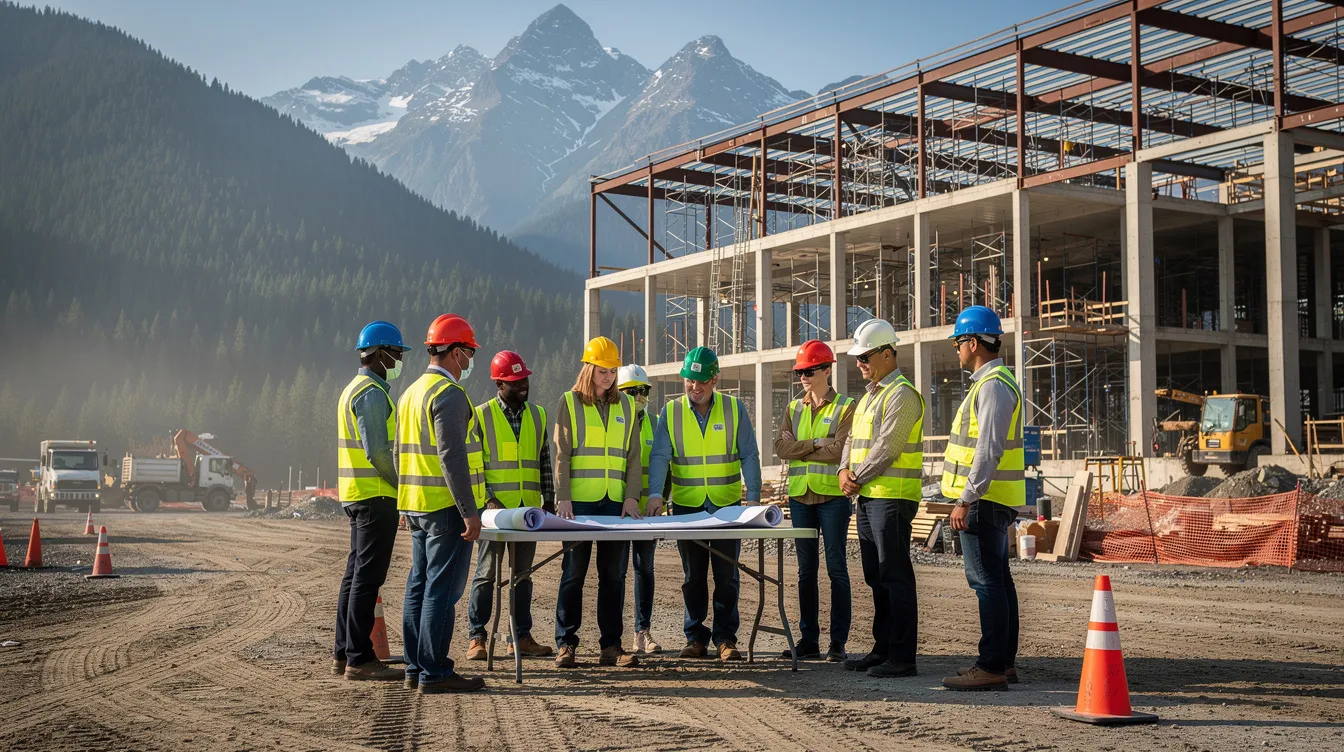
Construction safety leadership shapes how crews start work, how hazards are discussed, and whether supervisors follow the same rules they enforce. That matters in any market, but it is especially important for contractors trying to keep standards consistent across multiple jobs, offices, and supervisors.
Colorado and Wyoming also require awareness of different jurisdictions. Colorado is not an OSHA State Plan state for private-sector construction, so most private-sector construction employers in Colorado are covered by federal OSHA. Wyoming, by contrast, operates an OSHA-approved State Plan. Contractors working in both states should keep core expectations consistent while still reviewing jurisdiction-specific enforcement and documentation practices.
Beyond oversight structure, the operating context can differ from one project mix to another. Colorado work may involve tighter urban coordination and denser project activity, while Wyoming work may involve more dispersed sites and less direct supervisor reach. In either setting, strong field leadership helps close the gap between company policy and jobsite reality.
Most established contractors already have a safety manual, orientation process, and required documentation. That alone does not tell you whether construction safety leadership is strong. A better test is to compare what the paperwork says with what crews actually experience in the field.
| If you observe this | It usually means | What stronger field leadership looks like |
|---|---|---|
| Pre-task plans are completed, but crews cannot explain the day’s changing hazards. | Documentation is happening without real hazard communication. | Foremen review task sequence, crew assignments, changing conditions, and stop-work triggers before work starts. |
| PPE rules are enforced unevenly. | Supervisor example is inconsistent. | Supervisors and managers follow the same site rules regardless of rank or schedule pressure. |
| Near-misses are discussed only when something almost became serious. | The company is reacting late. | Near-miss reporting is treated as an early warning and reviewed for learning, not blame. |
| New hires hear one message in orientation and see another in the field. | Training is disconnected from operations. | Onboarding, coaching, and daily supervision reinforce the same expectations. |
| Standards drift from one jobsite to another. | Leadership habits are not repeatable yet. | Foremen, superintendents, and project managers operate from a consistent standard across projects. |
That is the practical pivot point for most contractors. The biggest improvement often comes from better supervisor execution, not from adding another policy.
If you want to know whether construction safety leadership is improving, watch the field. Completed forms matter, but visible behavior tells you more.
If several answers are no, the problem is usually not awareness. It is an execution gap in leadership.
Foremen and superintendents are where company expectations either become normal practice or break down. They control the quality of daily planning, the tone of hazard discussions, and the credibility of accountability.
Key expectations usually include:
Many field leaders are promoted because they are productive and technically strong. That does not automatically prepare them to coach, communicate, or stay consistent under pressure. When a contractor wants better safety performance, a good first question is whether supervisors have been trained and supported to lead, not just to build.
For companies pursuing more documentation-heavy work, Construction Quality Management certification can also be relevant. ABC Rocky Mountain’s verified CQM page notes that USACE and NAVFAC require contractor quality control managers to complete the course before performing those contract responsibilities. Contractors should still confirm current project requirements for the work they intend to pursue.
This is a proposed management approach, not a guaranteed outcome. The goal is to improve clarity, consistency, and supervisor follow-through without redesigning the entire company at once.
ABC Rocky Mountain serves merit shop commercial construction across Colorado and Wyoming and offers resources that can support stronger construction safety leadership. Members can explore Safety Programs, including STEP for benchmarking support, as well as peer learning and safety education. Contractors looking to strengthen broader operations can also review the Contractor Business Support Center.
For ongoing chapter commentary and industry updates, readers can use construction magazines and insights.
Construction safety leadership becomes real when the field sees the same message in planning, supervision, and follow-through. If you want a practical place to start, review ABC Rocky Mountain’s Safety Programs and identify the next improvement that fits your current project mix.


