


Rocky Mountain specialty contractors are facing a hiring landscape shaped by data center expansions, infrastructure spending, and federal backlogs. Construction quality management certification, often called CQM-C, is a USACE and NAVFAC credential that confirms a contractor’s quality control program meets federal standards and is frequently required on federal construction projects. The firms winning this battle are not just competing on wages. They are building quality management systems, developing foremen from within, and earning certifications that unlock higher-margin work and strengthen their hiring position.
For commercial and industrial contractors in Colorado and Wyoming—especially specialty trades, general contractors, QC managers, superintendents, foremen, project engineers, and high-potential journeymen—CQM-C connects workforce strategy to project performance. This article explains what the certification does, how the training supports career advancement and retention, where it fits in the region’s tight labor market, how it improves project delivery by reducing rework and supporting compliance, and how ABC Rocky Mountain helps members access certification and workforce development resources.
Associated Builders and Contractors reported through Construction Executive that the U.S. construction industry added 22,000 jobs in August 2026, with nonresidential specialty trade contractors accounting for 7,800 of those positions. The construction unemployment rate dropped to 3.1 percent. For Colorado and Wyoming firms, those numbers reflect a regional reality: backlogs are growing, qualified field leaders are scarce, and the ability to deliver a quality product on complex scopes separates thriving firms from those scrambling to fill seats.
Construction quality management certification (CQM) refers to the USACE and NAVFAC CQM-C credential, a program verifying that a contractor’s quality control program meets federal standards. CQM is a contractually mandated program for federal projects, and organizations like the US Army Corps of Engineers and the Naval Facilities Engineering Command (NAVFAC) offer CQM certification programs. The certification validates expertise in three-phase control, documentation, and coordination between the contractor and the government quality assurance team.
For Rocky Mountain construction professionals, this credential is no longer a compliance checkbox. It acts as a hiring and promotion signal, telling owners and federal agencies that a foreman, superintendent, or QC manager can protect schedules, margins, and safety. CQM certification differentiates candidates in the competitive construction job market by demonstrating commitment to construction quality and quality excellence.
The September 4, 2026 jobs report from Associated Builders and Contractors, based on Bureau of Labor Statistics data, confirmed that construction added roughly 22,000 jobs in August and that nonresidential specialty trades accounted for the largest share of 10,400 new nonresidential positions. Year over year, the industry is up 120,000 jobs, a 1.5 percent increase. Data center and AI-related backlogs are cited as primary demand drivers.

In Colorado, this national trend is showing up along the entire Front Range. Specialty trade contractor employment reached approximately 123,700 in June 2026, up from about 121,000 the prior month. Denver metro, Northern Colorado, and Colorado Springs are seeing sustained demand from data centers, highway upgrades, water infrastructure, and healthcare facility builds.
Wyoming presents a different scale but a similar challenge. Specialty trade construction employment rose approximately 6.0 percent year over year by mid-2025, with occupational projections showing construction trades workers growing roughly 14.3 percent from 2024 to 2034, and supervisors of trades growing about 10.7 percent. Federal, energy, and military installations keep demand steady across Cheyenne, Casper, and surrounding regions.
The real constraint is not raw headcount. The bottleneck is qualified foremen, superintendents, and QC managers who understand formal quality management and can run multi-trade scopes with the documentation discipline that federal and institutional owners demand. Professionals with CQM certification can command higher salaries and better compensation packages. CQM certification improves marketability and career growth opportunities in construction, and CQM-certified professionals have access to higher-level leadership roles in construction.
CQM-C is a joint US Army Corps of Engineers (USACE) and Naval Facilities Engineering Command (NAVFAC) program that aligns a contractor’s quality control with the government’s quality assurance on federal and military construction contracts. NAVFAC construction contracts and most USACE projects require that the designated quality control representative hold a valid CQM-C certificate before exercising QC responsibilities.
Certified construction professionals are trained in the three-phase control system (preparatory, initial, follow-up), documentation standards, definable features of work, and coordination among trades, testing labs, and government quality assurance (QA) representatives. CQM certification builds credibility and demonstrates a commitment to quality in construction. It enhances stakeholder trust through independent validation of competence.
What this signals to owners, primes, and hiring managers:
For Colorado and Wyoming specialty contractors, CQM-C on a resume helps candidates stand out for complex roles in data center construction, hospital and lab builds, water projects, and work on military installations in both states. Construction quality management dovetails with safety, schedule, and cost performance, reinforcing merit shop and performance-based project delivery.
The typical CQM-C course is a multi-day, instructor-led format developed by USACE and NAVFAC. ABC Rocky Mountain’s regional offering structures the program as 18 hours total: two days of in-person instruction plus about nine hours of on-demand pre-training. CQM training is required for designated CQC managers, who typically need three to five years of relevant construction experience before stepping into the role.
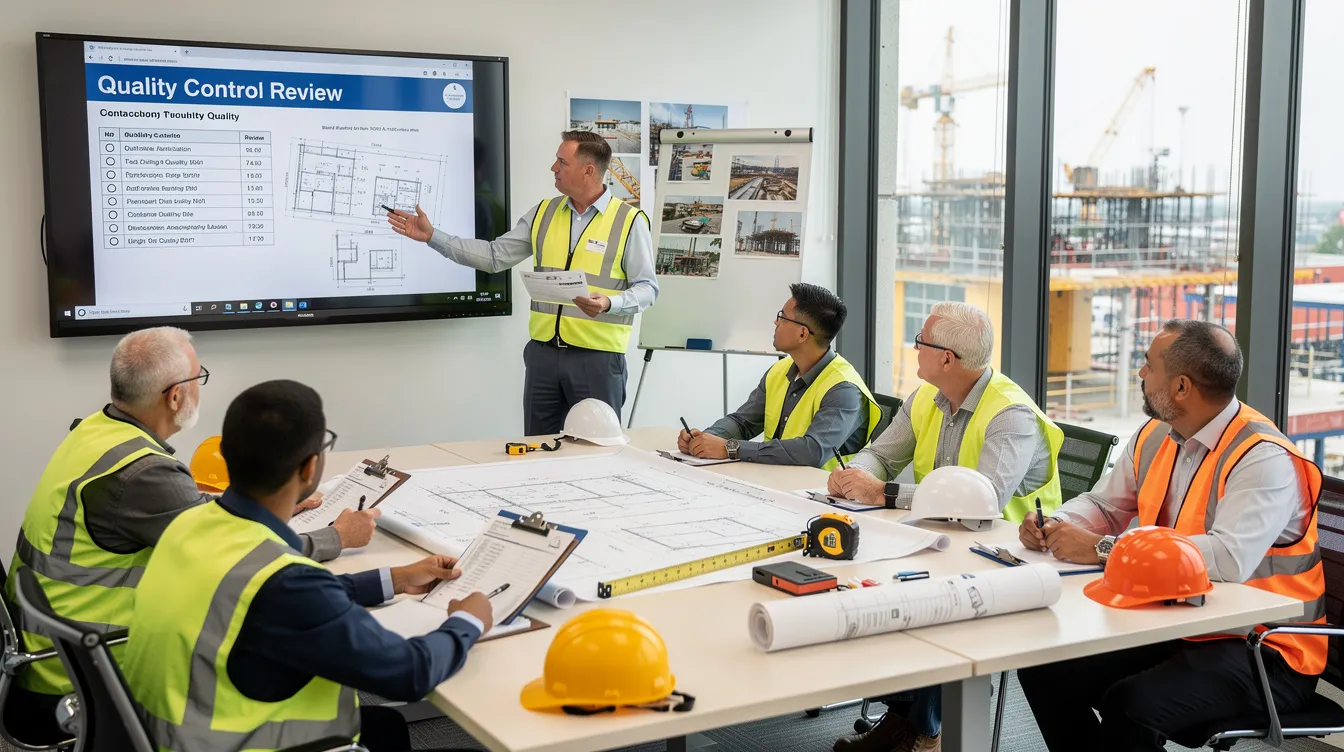
Core curriculum themes include:
The CQM course culminates in a final exam of 40 multiple-choice questions. A minimum passing score of 70 percent is required for certification. Upon successful completion, participants receive a CQM-C certificate recognized by USACE and NAVFAC, subject to current district validity rules. CQM certificates are valid for five years after issuance. After expiration, recertification requires retaking the course.
CQM classes emphasize practical tools: inspection checklists, deficiency logs, submittal registers, and student guide materials. Course materials and training materials are provided, often including an electronic copy for reference. Courses with digital components may require a mandatory technology check. Only courses approved by the local USACE district (such as the Omaha District or Washington District) satisfy the requirement; courses taught by NAVFAC trainers or NAFAC-sponsored instructors also qualify. Contractors should confirm questions prior to enrollment to ensure the CQM course meets local acceptance standards, as the final test and course certificate must align with current Engineer Circular guidance.
When contractors cannot simply buy experienced foremen in a tight market, they need a clear pathway to grow their own leaders. CQM-C can be positioned internally as a milestone in a foreman or superintendent development track, often after completing an apprenticeship or gaining journey-level experience. People aspiring to field leadership benefit from CQM as a credentialing step that demonstrates readiness.
CQM aims to build projects right the first time and avoid rework. That principle translates directly into developing field leaders who think proactively rather than reactively. Visible advancement opportunities, like quality management certification, are proven tools for improving retention among ambitious craft professionals. A Colorado electrical contractor, for example, might promote a journeyman who completed the Wyoming Electrical Apprenticeship Education Program into a QC-focused foreman position after earning a CQM-C certificate, gaining favorable recognition from both the company and project owners.
Companies can differentiate job offers by promoting a structured ladder:
This merit shop workforce pipeline gives craft workers a tangible path forward, reducing turnover and building worker pride. The contractor and employee share a clear goal: better performance, better pay, better outcomes.
Basic quality control catches defects after they occur. Quality management prevents them. Quality excellence is the sustained commitment to total quality across every scope and phase. CQM-C provides the framework to move from reactive inspection toward prevention and continuous improvement, a shift that directly impacts the bottom line.
CQM reduces disputes by approximately 40 percent compared to weak systems. Defined procedures address nonconforming work in CQM programs, and the prime contractor establishes a company-wide quality culture. The CQC manager coordinates all quality control responsibilities on a project, while subcontractors must comply with the prime contractor’s Quality Control Plan. Government QA representatives verify the contractor’s quality control system, and field engineers support the CQC manager by performing inspections.
On complex mechanical, electrical, concrete, or civil scopes common to Rocky Mountain projects:
Consider these scenarios: a Colorado Springs specialty contractor that implemented CQM-driven preparatory meetings on a data center project and cut reinspection rates significantly within one cycle, or a Front Range firm that shortened close-out by weeks through consistent deficiency logging and submittal tracking. Quality management succeeds when it becomes part of daily operations, not a binder on the shelf.
Colorado presents a dense hiring corridor. Denver, the Front Range, Northern Colorado, and Colorado Springs are all competing for the same pool of foremen, superintendents, and QC managers. Data center builds are surging; according to CBRE, data center construction across primary North American markets rose 24.8 percent in the first half of 2026. Highway, transit, water infrastructure, and healthcare projects add further pressure. Construction quality management certification is a differentiator in recruiting and promotions because it signals a candidate’s readiness for the documentation intensity these projects demand.

Wyoming operates at a different scale but faces parallel quality challenges. Federal and military work, energy infrastructure, and industrial maintenance keep demand steady for contractors who can meet USACE and NAVFAC quality standards. Remote job sites, high altitude, cold-weather concrete, and longer supply lines increase quality risk. Having CQM-C certified leadership on-site reduces that risk and is often required near installations.
Quality management principles are valued across various sectors, including civil and commercial construction. CQM supports risk reduction for owners, contractors, and end users in both states. Although regulatory environments differ between Colorado and Wyoming, contractors in both states benefit from a disciplined approach to quality assurance and quality control, and merit shop firms in both jurisdictions can leverage CQM to document performance and protect margins. Associated General Contractors and other industry groups also recognize the value of quality credentialing, but ABC Rocky Mountain’s regional delivery model directly serves the two-state corridor.
The primary roles for which CQM training makes strategic sense:
| Role | Why CQM Matters |
|---|---|
| QC Manager | Directly responsible for executing the contractor’s quality control program on every federal or quality-critical job |
| Superintendent | Oversees multi-trade coordination and must understand quality assurance QA expectations |
| General Foreman | First line of defense for three-phase control and inspection discipline |
| Project Engineer / PM | Must understand how quality requirements impact bids, schedules, and subcontractor management |
| High-potential Journeyman | Candidates in electrical, piping, civil, concrete, mechanical, or sprinkler fitting who have completed apprenticeship and show aptitude for documentation |
HR leaders and operations executives should audit current and upcoming projects for CQM-sensitive scopes, then map internal candidates whose promotion would strengthen both project delivery and retention. Ensure that at least one CQM-certified leader is present on each federal or quality-critical job, and cross-train additional staff to avoid single points of failure. Builders and contractors (ABC) member firms in particular can leverage regional CQM classes to build this bench depth efficiently.
A practical checklist for 2026:
ABC Rocky Mountain serves as a regional hub for construction education, safety, workforce development, and CQM resources across 60 counties in Colorado and Wyoming. The chapter connects members to USACE and NAVFAC-recognized CQM-C courses, scheduling guidance, and updates on current federal requirements. Links on the chapter’s education and CQM pages provide access to upcoming class dates, registration, and regional course availability.
Complementary programs strengthen the impact of CQM training: NCCER-accredited apprenticeship through CITC, the Wyoming Electrical Apprenticeship Education Program, ConstructionU leadership courses, and safety programs like STEP and the Safety Peer Group. Together, these form the merit shop workforce pipeline that helps general contractors and specialty contractors working effectively across the Rocky Mountain region improve quality, retain talent, and win work.
Contact ABC Rocky Mountain to review upcoming CQM classes, reserve seats for your foremen and QC managers before the Friday prior to class deadlines, or discuss a broader workforce and quality strategy for 2026 and beyond. The engineers and construction professionals who earn this credential position themselves and their firms for sustained growth.
The following questions address the most common concerns Colorado and Wyoming contractors raise when exploring CQM training and certification for their teams.
While CQM-C is a formal requirement on many USACE and NAVFAC contracts, the principles translate directly to private data centers, industrial facilities, healthcare projects, and infrastructure work throughout Colorado and Wyoming. Many owners and general contractors view CQM-C as proof that a contractor can manage documentation, inspections, and coordination on any complex project. In competitive hiring situations, the credential also helps candidates stand out for foreman, superintendent, or QC manager roles even on purely private projects. A satisfactory, complete understanding of quality systems benefits every scope, not just those tied to the Army Corps of Engineers (USACE).
Contractors often see early benefits within a single project cycle when certified leaders start implementing three-phase control, better preparatory meetings, and more consistent deficiency tracking. Over two to three projects, firms typically report fewer repeat defects, faster close-outs, and improved owner confidence, especially when CQM is paired with stronger supervision and safety programs. Start by piloting CQM practices on one or two high-visibility projects in Denver, Northern Colorado, Colorado Springs, or Wyoming to build internal momentum and proof of value.
Tuition varies by provider and format. Regional ABC Rocky Mountain and USACE Omaha District classes have been offered at approximately $250 per student. Contractors should budget not only for registration fees but also for paid training time, travel if needed, and backfill coverage for key leaders while they attend the contractor’s class. Treat CQM as a capital investment in leadership and quality excellence, not a one-off expense, by comparing the cost of training with typical rework, warranty, and turnover costs. Schedule CQM-C in alignment with planned federal or major project pursuits so that the certification directly supports upcoming revenue opportunities.
CQM does not replace existing safety programs, quality manuals, or project management software. Instead, it provides a disciplined CQM framework that can integrate with those systems. Contractors often embed three-phase control and CQM documentation requirements into standard pre-task planning, toolbox talks, and inspection checklists, aligning quality control with OSHA and STEP safety practices. Involve both safety managers and QC leaders in CQM implementation so that quality and safety reinforce each other rather than operating in separate silos. The Baltimore District and other USACE offices have provided guidance on how valid issued certificates interact with local project requirements.
Start by identifying 2026 pursuits where CQM-C will be required or highly advantageous, such as federal, military, or large institutional projects in Colorado or Wyoming. Then review ABC Rocky Mountain’s CQM certification and education resources to confirm current course offerings, prerequisites, and registration timelines. Select an initial cohort of high-potential foremen, superintendents, or QC managers for early enrollment and successfully complete the CQM-C course before contract award deadlines. Align that training with broader workforce initiatives like apprenticeship and field leadership development to maximize the return on every seat you fill.


